Insights|
How to improve your VO₂ max: a coach’s guide, and how our team trains
By Nick Arapis, CSCS, CMES, Chief Operating Officer, Optispan
You improve your VO₂ max by doing a lot of easy aerobic exercise and adding one or two hard interval sessions each week, then sticking with it for months. That’s the short answer. The rest of this article covers why VO₂ max deserves the effort, what a good number looks like for your age, and how three people on our team fit the training into busy lives.
What VO₂ max is
VO₂ max is the most oxygen your body can take in and use during all-out exercise. I think of it as the size of your aerobic engine. It’s the combined work of your heart, lungs, blood and muscles.
It’s reported in milliliters of oxygen per kilogram of body weight per minute (mL/kg/min). Some labs report it in METs instead, where 1 MET equals 3.5 mL/kg/min. Either way, a bigger engine lets you do more with less strain. You notice it when you take the stairs without getting winded, carry luggage through an airport, keep up with your kids on a hike, or recover faster after being sick.
Why it matters for how long and how well you live
VO₂ max is one of the strongest predictors of survival ever measured. In a 2018 Cleveland Clinic study published in JAMA Network Open, researchers followed 122,007 adults who had completed treadmill tests. People in the lowest fitness group had about five times the risk of death of those in the top group (adjusted hazard ratio 5.04). The benefit kept rising with fitness, and the researchers found no upper limit.
A hazard ratio compares the chance of an event, here death, between two groups over time. A higher number means higher risk. In the same study, low fitness carried as much risk as smoking (hazard ratio about 1.41), diabetes (about 1.40) or high blood pressure (about 1.21), or more.
None of this gives a fit person a free pass to smoke. In practice, though, people who train hard enough for a high VO₂ max rarely have those habits.
| Fitness category | 10-year survival |
|---|---|
| Poor | 77% |
| Fair | 91% |
| Good | 93.5% |
| Excellent | 96% |
| Superior | 97% |
What’s a good VO₂ max for your age?
VO₂ max naturally drops with age, so you’re compared with people of your own age and sex. At Optispan, every client’s first goal is the top 20 percent for their age and sex, which reference charts label “high.” Once a client reaches that, we can aim for the top 10 percent, sometimes called “superior” or “elite.” Many of our clients and staff train for it.
| Age | Women, top 20% | Men, top 20% | Women, top 10% | Men, top 10% |
|---|---|---|---|---|
| 30–39 | 37.0 | 50.0 | 42.1 | 55.5 |
| 40–49 | 33.0 | 45.2 | 37.8 | 50.8 |
| 50–59 | 28.4 | 38.3 | 32.4 | 43.4 |
| 60–69 | 24.3 | 32.0 | 27.3 | 37.1 |
How VO₂ max is measured
Smartwatches estimate VO₂ max from your heart rate and pace. Those estimates are useful for spotting trends, but they can be off by a meaningful amount for any one person.
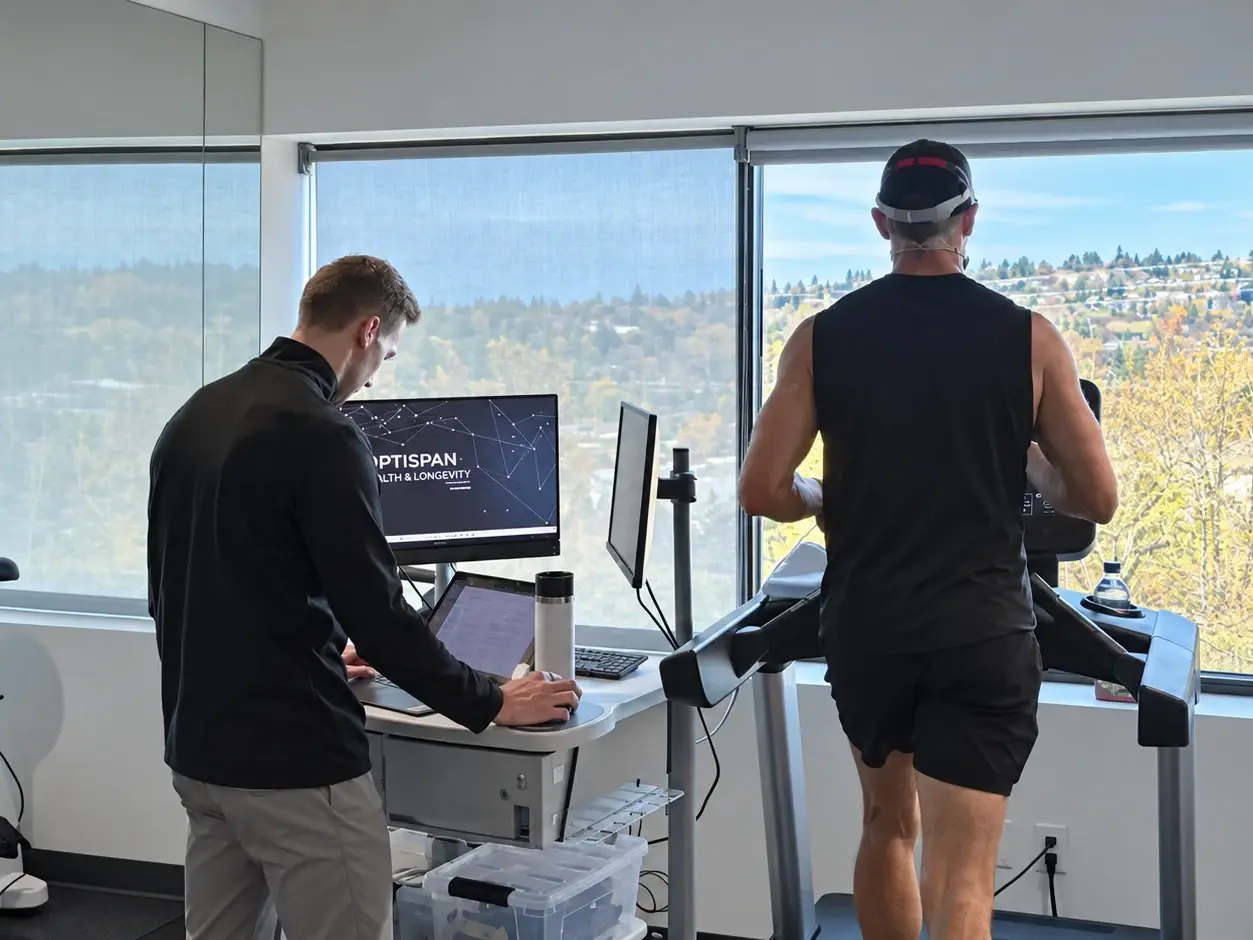
A lab test measures it directly. You exercise on a treadmill or bike while wearing a mask that measures the oxygen you breathe in and the carbon dioxide you breathe out, and the effort ramps up until you reach your limit. At Optispan, this test is part of the Gateway Day. Most clients retest once or twice a year. The test also gives us your personal heart rate zones, so your training targets come from your own physiology rather than an age formula.
How to improve your VO₂ max
There are dozens of studies comparing training protocols, and some point to an “optimal” plan on paper. But a plan you can’t stick with isn’t optimal for you. Most effective programs come down to a few principles.
- Build a big aerobic base with Zone 2. Zone 2 is steady exercise at an effort where you can still talk in full sentences. Brisk incline walking, easy cycling and light jogging all count. It trains your heart to pump more blood with each beat and helps your muscles use oxygen better. Most of your weekly cardio should be here: two to four sessions of 30 to 60 minutes.
- Add one or two hard sessions a week. Intervals near your maximum heart rate push the top of the engine. A well-studied option is the Norwegian 4x4: four minutes at a hard effort (about 85 to 95 percent of max heart rate), three minutes easy, repeated four times. Tabata (20 seconds all-out, 10 seconds rest, eight rounds) and hill or stair repeats work too. One or two of these a week is enough for most people.
- Increase gradually. Add time before you add intensity. A small weekly increase in total minutes is easier to recover from than a sudden jump.
- Keep doing resistance training. Strength training doesn’t raise VO₂ max much, but muscle is its own healthspan marker. Every member of our team below lifts weights.
- Retest. If you’re consistent, measurable gains usually show up within a few months. A retest tells you whether the plan is working and resets your zones as you get fitter.
How our team trains
We have very different schedules and preferences, yet each of us keeps our fitness high. Look for the approach that sounds doable for you.
Nick Arapis, CSCS, CMES
My favorite cardio tool is the walking pad or treadmill because it’s so easy to adjust. As I write this, I’m walking at 4.0 mph on a 4 percent incline. My heart rate is around 130 beats per minute, which is comfortable but a bit below my Zone 2. To get there, I’d need about a 10 percent incline at the same speed.
I think of a treadmill as having three levers:
- Speed, the obvious one.
- Incline, which raises your heart rate without having to run.
- Load, like a weighted vest. I sometimes wear a 20-pound vest to make a session harder without changing anything else.
I do cardio three to four days a week. One of those sessions is intervals that take my heart rate close to max, often above 190. The rest are steady. I also lift three times a week and hit every muscle group twice, prioritizing intensity over volume. With two young kids and a full work schedule, I want every gym minute to count.
Dr. Nicki Byrne, MD
I started running in medical school to manage stress, and it’s been part of my life ever since. I ran two marathons before having kids. These days my usual run is an easy four or five miles.
Now that both my kids are confident on their bikes, we often head to the beach after work. They ride and I run alongside, so I get my exercise and family time together. When the weather keeps us inside, I do Tabata sprints on the treadmill or a Peloton ride. Several times a week I walk my dog wearing a weight vest for extra weight-bearing work. I also do three strength sessions a week: lower body, upper body and full body.
Matthew McCool
I balance hard and easy cardio with strength work and recovery. Mondays are a high-intensity kettlebell interval session. On Tuesdays, Thursdays and Fridays I lift and get 10,000 steps. Wednesdays are a five-to-seven-mile run, which also clears my head.
On Saturdays I either do six rounds of stair intervals in a weighted vest or play basketball, which adds agility and a social element. Sundays are active recovery: 10,000 steps and no structured training.
The bottom line
I think VO₂ max belongs alongside muscle mass (measured by DEXA) and grip strength as a vital sign for healthspan. It isn’t only a performance number. It’s one of the best signs of how long and how well you’re likely to live, and you can change it at any age.
Our playbook is to move often to build the base, go hard once or twice a week, retest and adjust. Aim for the top 20 percent for your age and sex first. If you want to keep climbing from there, go for the top 10 percent.
Want to know your real VO₂ max and your personal training zones? Book a free 15-minute consultation.
Frequently asked questions
How long does it take to improve VO₂ max?
Most people who train consistently see measurable gains within a few months. People starting from a lower fitness level usually improve fastest.
Can you improve VO₂ max after 50?
Yes. VO₂ max declines with age, but it responds to training at any age, and staying fit slows the decline.
Is Zone 2 enough to raise VO₂ max?
Zone 2 builds the base, and beginners often improve on it alone. Adding one or two harder interval sessions a week usually raises VO₂ max further.
Are smartwatch VO₂ max readings accurate?
They’re good for tracking trends over time. For an exact number and personal heart rate zones, a lab test that measures your breathing is more reliable.
This article is for general information. Check with your physician before starting a new exercise program.